

Bubble Tea Industry: From Trend to Scalable Global System
✨ Introduction
In the past, bubble tea was often seen as a trendy beverage focused on flavor creativity and customization. With a wide variety of toppings and personalized options, it quickly captured consumer attention.
However, as global demand continues to grow and brands expand internationally, the bubble tea market is evolving into a structured industry built on standardization and scalability.
According to industry insights from market research firms such as Future Market Insights, the global bubble tea market is expected to continue expanding steadily over the next decade. This growth is driven not only by increasing consumer demand, but also by the maturation of the industry in areas such as ingredient supply, production standardization, and distribution channels.
This shift signals that bubble tea is no longer just a beverage product — it has become a scalable business model that can be systemized, replicated, and expanded globally.
🌍 Why the Bubble Tea Industry Is Highly Scalable (Why This Industry Matters)
The growth of the bubble tea industry is not driven solely by product innovation, but by the balance between consumer experience and operational efficiency.
From a market perspective, bubble tea offers several key characteristics:
-
High customization (sugar level, ice level, toppings)
-
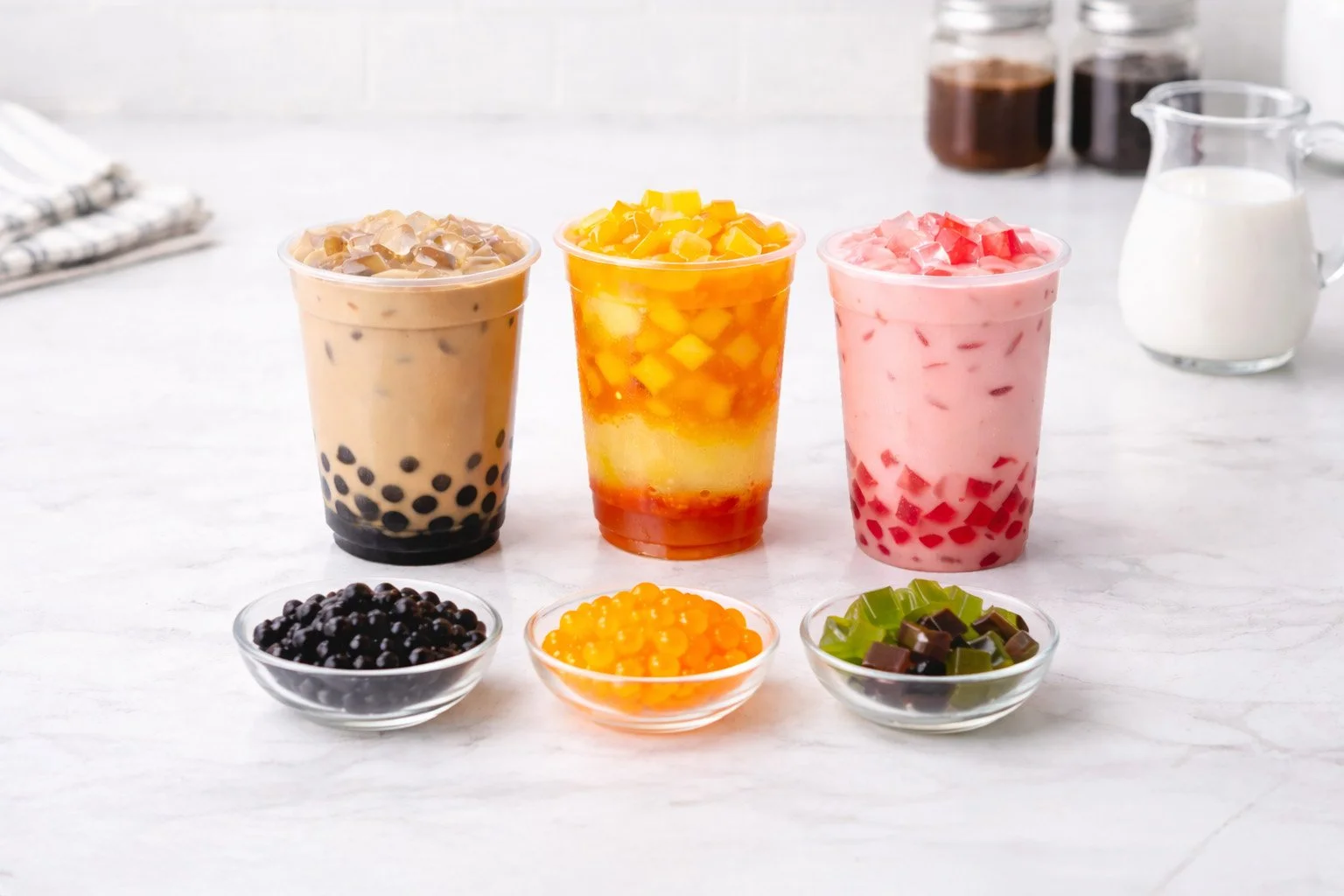
Multi-layered texture experience (pearls, popping boba, jellies)
-
Continuous flavor innovation
These factors make bubble tea highly appealing and capable of generating sustained demand.
However, the real driver behind long-term industry expansion lies in:
👉 Standardization and replicability
This shift also means that ingredient selection and production design are becoming critical factors in determining whether a brand can scale successfully.
As highlighted in various market analyses, the bubble tea industry is transitioning from a trend-driven model to a system-driven model, forming a complete ecosystem that includes ingredients, product formats, and distribution channels.
Within this structure, brands are able to:
-
Expand rapidly across regions
-
Build franchise and chain systems
-
Maintain consistent product quality and flavor
In other words, success is no longer defined by whether a drink tastes good, but whether it can be consistently replicated at scale.
🧪 How Product Structure Supports Scalability (Flavor & Functional System)
One of the key reasons bubble tea can scale efficiently is its modular product structure, allowing flexibility across different markets while maintaining consistency.
A typical bubble tea drink consists of the following core components:
-
Tea base
-
Sweetener system (syrup or sugar solution)
-
Dairy or non-dairy alternatives
-
Toppings (such as tapioca pearls or popping boba)
This modular design provides several advantages:
✔ Enables rapid menu expansion✔ Allows flavor adaptation across markets✔ Supports standardized and repeatable preparation processes
In real operations, these elements directly impact product stability and operational efficiency. For example, the choice of sweetener system, storage conditions of toppings, and preparation methods all influence service speed, consistency, and staff training requirements.
Therefore, for brands aiming to scale, the focus should not be on a single recipe, but on building a complete and controllable ingredient system that ensures consistent results across locations.
In practical applications, the stability and compatibility of different ingredients play a crucial role in scalability. For instance, rapidly growing products like popping boba require careful consideration in terms of temperature resistance and performance across different beverage formats.
👉 Related Article: How Popping Boba Is Shaping Global Beverage Trends
🏭 How Bubble Tea Achieves Consistency in Production (Production Logic)
As brands begin to scale, the biggest challenge shifts from innovation to consistency:
👉 How to ensure every drink tastes the same across locations and time
To achieve this, the industry has developed a standardized production framework that enables consistent replication across stores and markets.
This system typically includes:
1️⃣ Ingredient Standardization
Pre-designed syrups, powders, and toppings reduce human error and ensure consistent flavor
2️⃣ SOP-Based Processes
Standardized procedures allow staff across locations to produce the same quality
3️⃣ Storage and Stability Management
Ensures ingredients maintain quality during transportation and storage
4️⃣ Reduced Labor Dependency
Systematic processes allow efficient operations with less reliance on highly skilled staff
Under this model, the role of suppliers has evolved — from simply providing ingredients to becoming key partners in enabling scalable growth.
As a result, many international brands choose to work with experienced Taiwan bubble tea suppliers, not only for reliable ingredient sourcing but also for building long-term production systems.
In practice, these suppliers often go beyond product supply, supporting brands in formulation design, process optimization, and production scale-up. For example, Yujie Food positions itself as a partner that helps brands establish standardized systems from the early stages of product development, ensuring smoother expansion.
As brands continue to grow, the ability to transform ingredient systems into fully standardized production workflows becomes a critical success factor.
🏪 From Single Store to Global Chain (Application in Real Business)
As the market matures, the bubble tea industry is shifting from independent store operations to chain-based and brand-driven models.
This transition is supported by a replicable operational framework that includes:
-
Standardized menu design
-
Centralized ingredient sourcing
-
SOP-based workflows
-
Consistent brand experience
By integrating these systems, brands can replicate operations across regions while minimizing variability caused by staff or environmental differences.
This enables businesses to:
-
Enter new markets more efficiently
-
Reduce operational risks and inconsistencies
-
Improve overall efficiency and scalability
When product design, ingredient systems, and production workflows work together, bubble tea becomes more than a successful product — it becomes a scalable and sustainable business system.
💡 Key Insights for Brands and Entrepreneurs (Business Insight)
For brands looking to enter or expand in the market, competition is no longer centered on the product itself, but on the ability to build and integrate scalable systems.
The key question is:
👉 Does your business have a scalable operation system?
This capability is reflected in several areas:
-
Stability and usability of ingredients
-
Standardized and replicable production processes
-
Ability to support multi-location and cross-market operations
-
Reliable long-term supply and quality control
Within this industry landscape, a brand’s growth potential depends on its ability to build a complete and controllable system — not just a successful product.
Therefore, choosing the right partner is no longer just a procurement decision, but a strategic factor that directly impacts scalability.
In practice, this includes:
-
Ingredient system optimization
-
Production workflow design
-
End-to-end product development and scaling
For example, Yujie Food supports brands by integrating ingredient development with OEM production capabilities, helping clients implement scalable thinking from the product design stage. This enables greater flexibility and stability when expanding into different markets and channels.
For brands aiming to compete globally, establishing the right ingredient strategy and production system from the beginning will directly influence long-term success and growth potential.
